Project overview
CactusVPN is a VPN and Smart DNS service provider that helps users protect their online privacy, encrypt their internet connections, and access geo-restricted content worldwide.
- Goal: Build a sustainable organic traffic channel from scratch, establish topical authority in the VPN space, and reduce reliance on paid acquisition
- My role: Led SEO and content strategy from launch, while also contributing to UI/UX design, web development, and project management as a managing partner
Situation and challenge
I joined CactusVPN at launch in 2011 as a co-founder and managing partner. The company was entering the VPN industry, one of the most competitive SEO landscapes online.
Starting from zero: A brand-new product on a brand-new domain, with no organic presence, no content and no backlinks. Everything had to be built from the ground up.
Heavy competition: The VPN niche is dominated by well-funded competitors with large content teams, big link-building budgets and established domain authority. Ranking for high-value VPN keywords is hard.
Small team: Competitors had dedicated SEO departments. I handled SEO alongside UI/UX design, web development and project management.
The job: build a content and SEO strategy that could compete with, and outrank, companies with many times our resources.
Strategy and execution
Rather than competing head-on for the hardest short-tail keywords from day one, I designed a content architecture that built topical authority step by step and captured traffic at every stage of the user journey.
1. Content architecture: three pillar hubs
I structured the site’s educational content around three core pillar hubs, each targeting a distinct topic cluster:
- Beginner’s Guide to VPN (37 pages). VPN fundamentals: what is a VPN, how VPN works, VPN protocols (IKEv2, OpenVPN, PPTP, SSTP, L2TP), VPN features, and use cases.
- Beginner’s Guide to Online Security (21 pages). In-depth guides on internet security topics: DNS hijacking, encryption, firewalls, browser security, and threat protection.
- Beginner’s Guide to Online Privacy (8 pages). Focused content on IP address privacy, internet surveillance, ISP tracking, and anonymous browsing.
Each hub was supported by dozens of interlinked in-depth articles, so the whole cluster showed search engines the site covered the topic fully.
2. In-depth educational content
Beyond the pillar hubs, I created and optimized a library of standalone educational articles targeting specific keyword clusters:
- VPN articles covering protocol comparisons, VPN vs. alternatives (firewall, antivirus, HTTPS, proxy), streaming unblocking guides, torrenting privacy, and product comparisons (PeerBlock vs VPN).
- Privacy articles targeting high-intent queries about IP address privacy, what someone can do with your IP, internet surveillance, and how to encrypt internet connections.
- Smart DNS articles, dedicated content for the Smart DNS product line, covering geo-restrictions, streaming, and setup guides.
3. A large tutorial library
I built a library of 230+ step-by-step setup guides covering the combinations of:
- Platforms: Windows, macOS, iOS, Android, Android TV, Fire TV, Roku, Apple TV, PlayStation, Xbox, routers
- Protocols: OpenVPN, IKEv2, PPTP, L2TP/IPSec, SSTP, SoftEther
- Products: VPN app setup, Smart DNS setup, browser extensions (Chrome, Firefox), proxy configuration
Each tutorial was a long-tail SEO asset, targeting very specific queries like “how to set up OpenVPN on Android” or “Smart DNS setup on WD TV.” Each page brought modest traffic on its own, but together the 230+ tutorials added up to a large organic footprint.
4. Product and commercial pages
- VPN server location pages: dedicated landing pages for each server location, targeting geo-specific search queries (e.g., “VPN server in Germany,” “US IP address”).
- VPN service pages: product feature pages, pricing, comparison pages, and free trial landing pages targeting commercial and transactional keywords.
- News and announcement posts: regular product updates, new server announcements, feature launches, and company news to keep the site fresh and demonstrate ongoing development.
5. Multilingual expansion
Once the English content strategy was proven, I scaled the entire site into 6 additional languages: French, Russian, Spanish, German, Portuguese and Turkish.
Each language version needed its own keyword research, adapted metadata, correct hreflang and localized URL structures, so it could perform in its market.
6. Technical SEO foundation
Throughout the engagement, I managed all technical SEO:
- Site architecture and URL structure design
- Internal linking strategy across pillar hubs, articles, tutorials, and product pages
- Page speed optimization and Core Web Vitals
- Crawlability and indexation management
- Schema markup implementation
- A/B testing to improve CTR on key pages
Results
The results built up over a decade of consistent work:
Keyword rankings
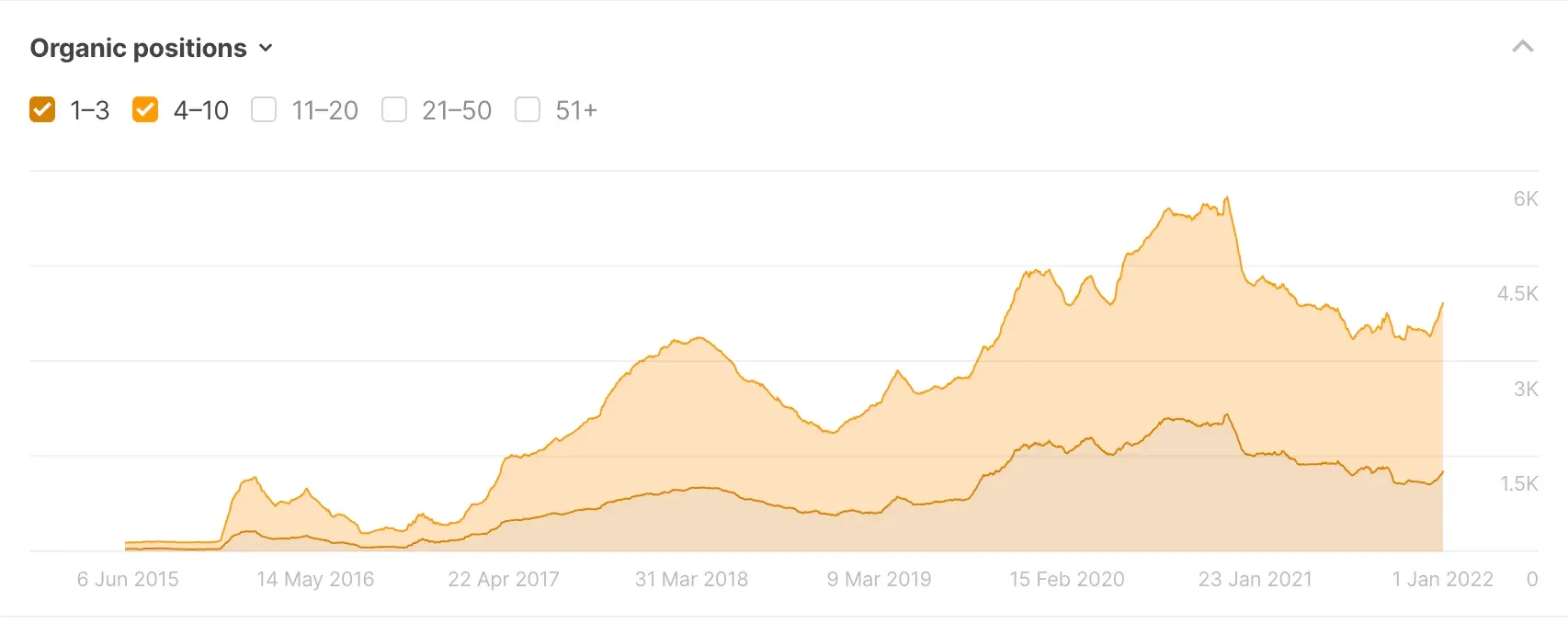
Scaled organic keyword rankings from zero to 6,000+ in the top 10, with peak visibility exceeding 6,500 combined positions in the 1–3 and 4–10 ranges.
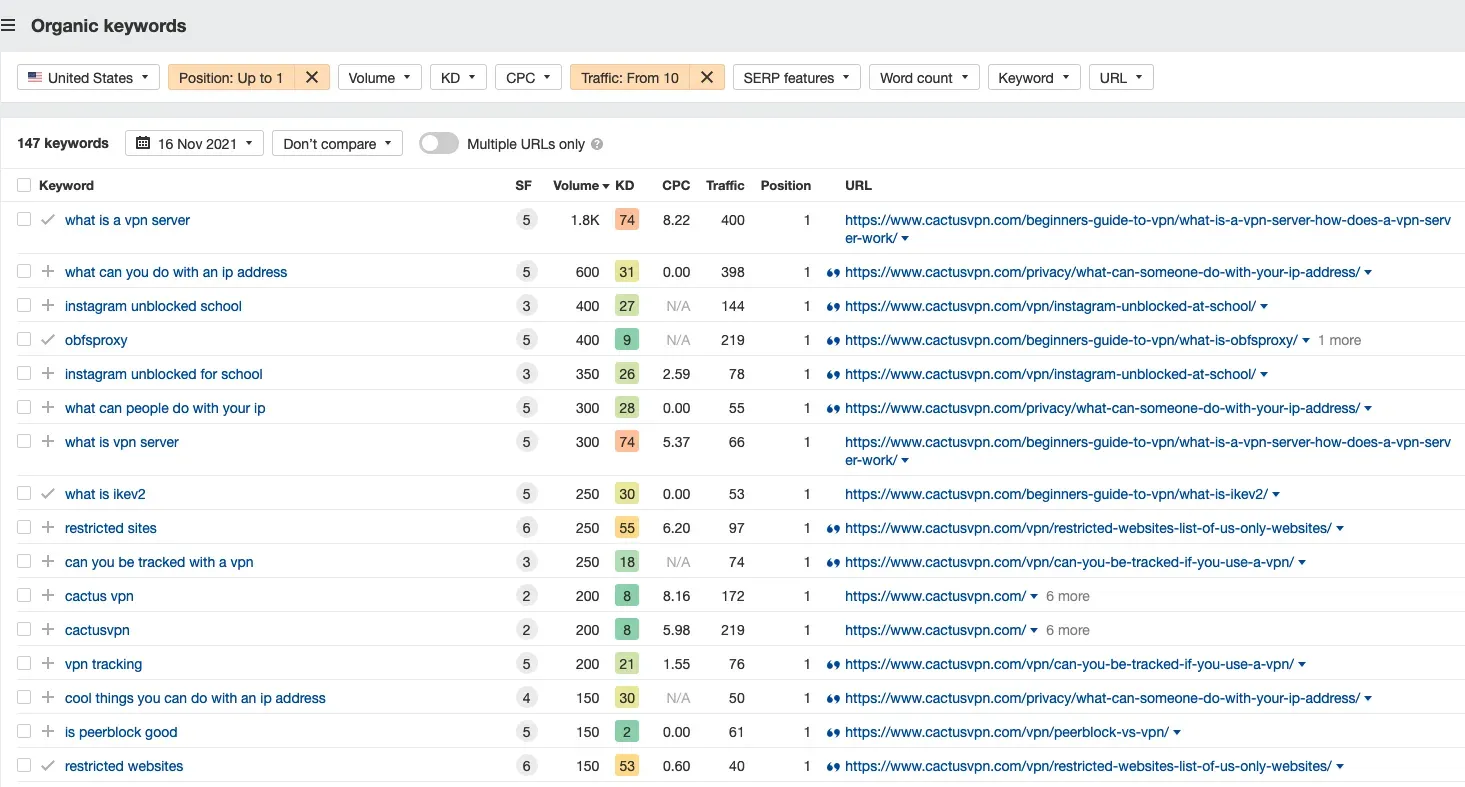
Secured 147 #1 positions in the US market alone, for competitive keywords including:
- “what is a vpn server” (1.8K monthly volume)
- “what can you do with an ip address” (600 volume)
- “instagram unblocked school” (400 volume)
- “obfsproxy” (400 volume)
- “what is ikev2” (250 volume)
- “restricted sites” (250 volume)
- “can you be tracked with a vpn” (250 volume)
- “cactus vpn” / “cactusvpn” (200 volume)
- “vpn tracking” (200 volume)
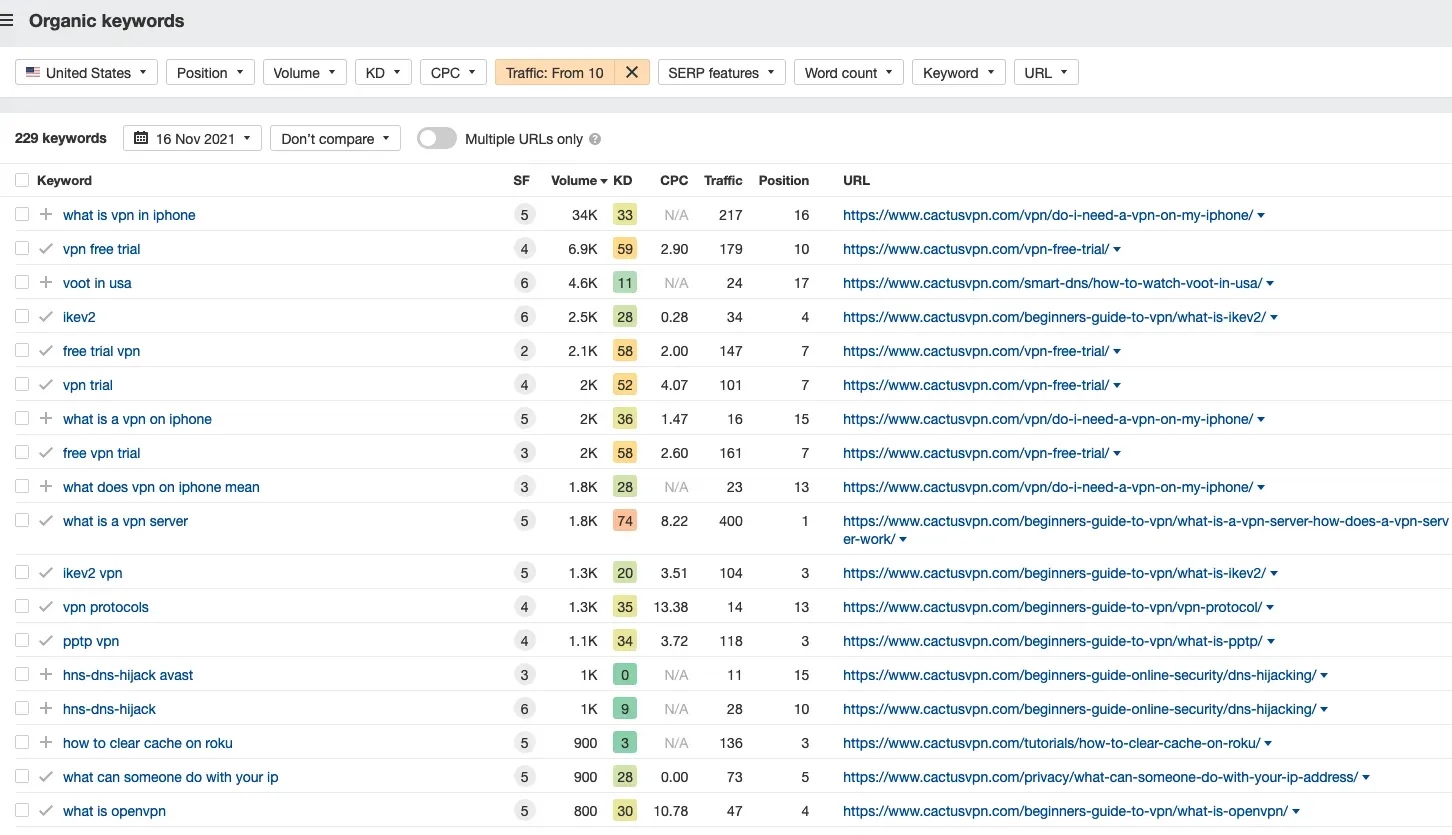
Ranked 229 keywords that drove meaningful traffic in the US alone, led by “what is vpn in iphone” (34K volume), “vpn free trial” (6.9K volume) and “ikev2” (2.5K volume).
Traffic growth
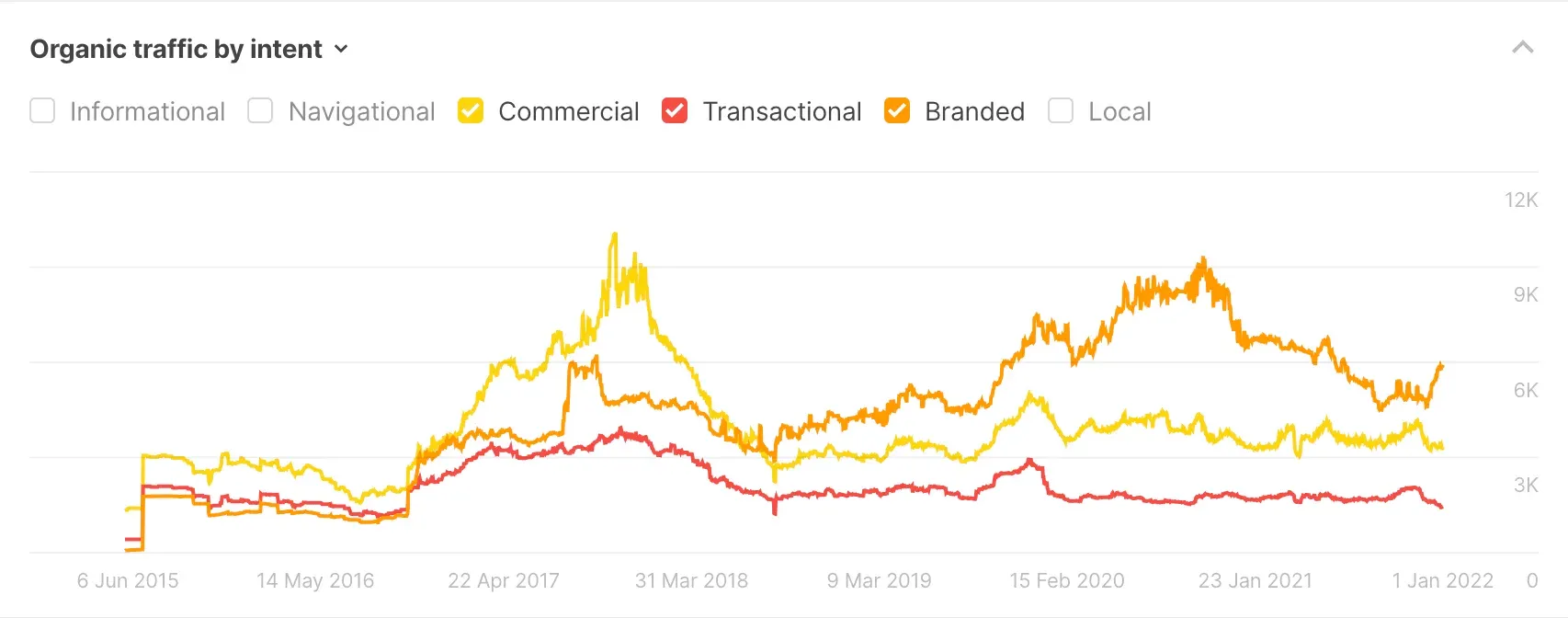
Grew commercial-intent traffic from near zero to consistent peaks of ~12,000 monthly visits, so the content brought in buyers, not only informational clicks.
Built branded search traffic to peaks of ~9,000 monthly visits, as organic visibility made more people aware of the brand.
International SEO
Reached #1 rankings in the US, Germany and France, with very high click-through rates:
United States:
- “instagram unblocked school”: position 1.1, 12.4% CTR
- “what can you do with an ip address”: position 2.6, 12.7% CTR
- “how does openvpn work”: position 1, 52.1% CTR
Germany:
- “was kann man mit einer ip adresse anstellen”: position 1, 54.8% CTR
- “vpn welches land”: position 1, 42.5% CTR
- “was kann man mit einer ip-adresse von jemand anderen anstellen”: position 1, 39.5% CTR
France:
- “que peut on faire avec une adresse ip”: position 1.1, 58% CTR
- “que faire avec une adresse ip”: position 1, 54.8% CTR
- “la surveillance d’internet”: position 1, 51.9% CTR
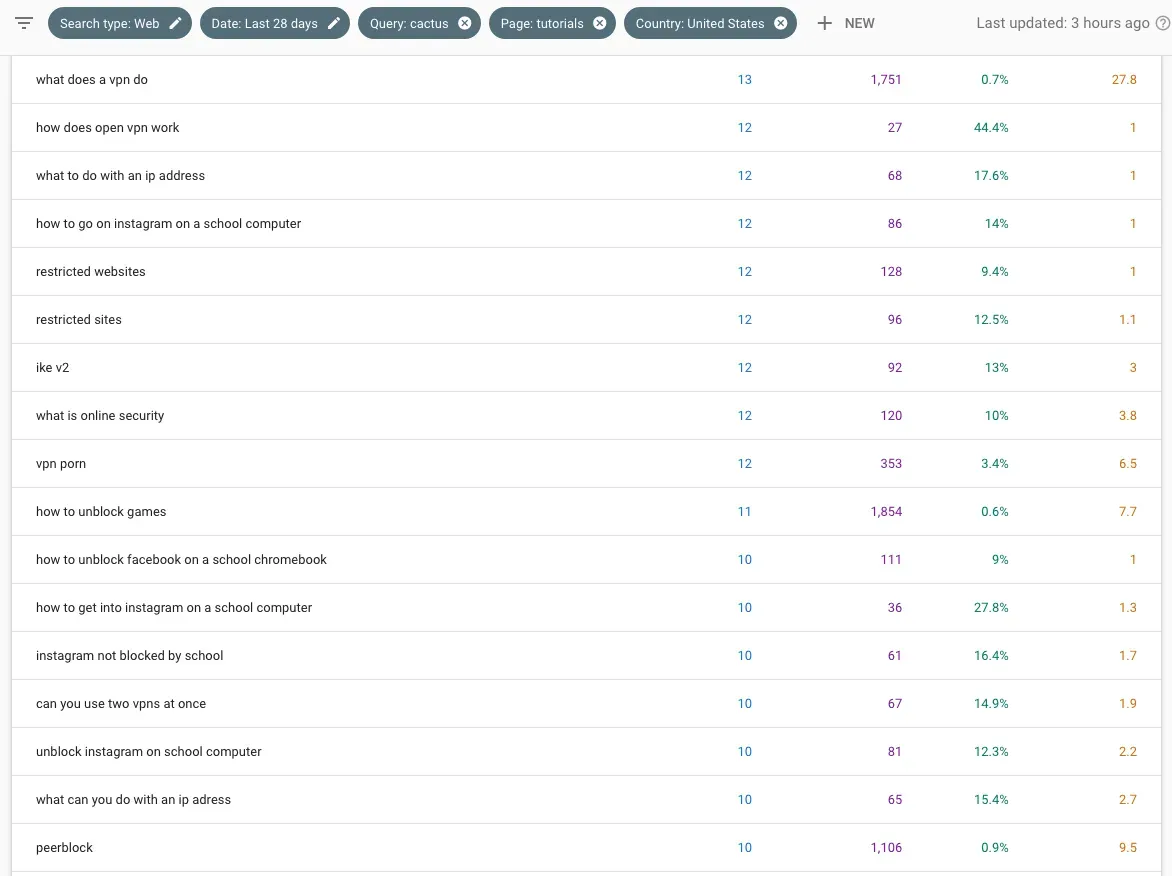
CactusVPN Google Search Console keywords USA
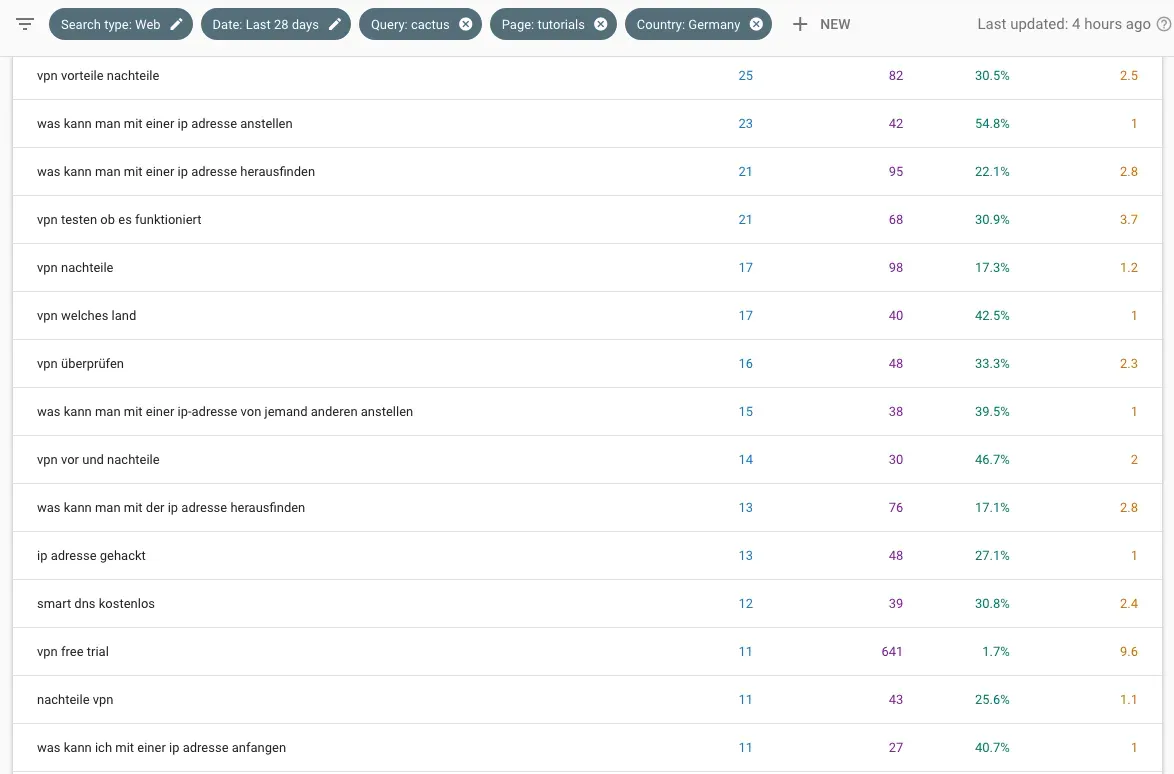
CactusVPN Google Search Console keywords Germany
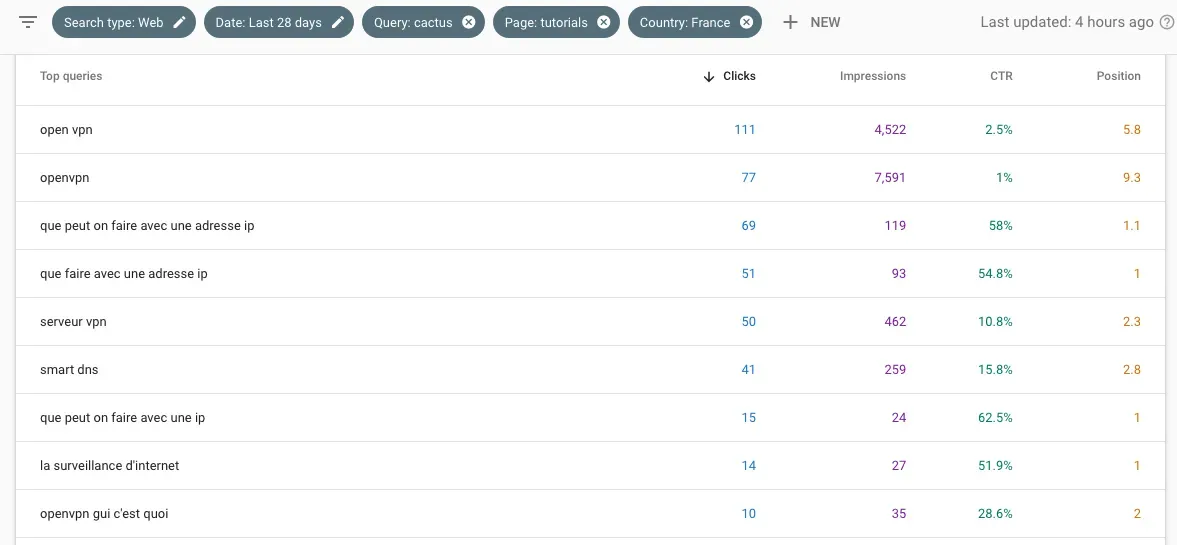
CactusVPN Google Search Console keywords France
Content scale
Built a content library of 550+ English pages spanning educational articles, tutorials, product pages, and news content.
Scaled to nearly 1,000 total indexed URLs across 7 languages (English + 6 translations with 436 localized URLs).
Impact
Over more than ten years, CactusVPN went from a brand-new product with no online presence to a recognized name in VPN and online privacy. Organic search became a steady traffic source that reduced dependence on paid acquisition and built the brand over the long term.
The context matters: VPN is one of the hardest niches in SEO, with well-funded competitors spending millions on content and link building. The site still reached 6,000+ top-10 rankings and #1 positions in the US, Germany and France, on the strength of a well-planned content architecture and years of consistent work.