Project overview
SSL Dragon sells SSL certificates to businesses worldwide, at affordable prices, from leading Certificate Authorities including DigiCert, Sectigo, GeoTrust, RapidSSL, and Thawte. Founded in 2014, the company has sold thousands of SSL certificates to customers in 120+ countries.
- Goal: Audit and optimize the entire existing content library, build a scalable multilingual content strategy, and establish the site as a topical authority in SSL and web security
- My role: SEO strategist: content auditing, on-page optimization, content strategy, technical SEO, and multilingual SEO expansion
Situation and challenge
When I started working with SSL Dragon in October 2022, the company had a functional website with existing content, but organic search was performing well below its potential.
Underperforming content library: The site had over 500 pages: 150+ blog articles, 80+ product pages, 50+ landing pages, and 200+ tutorials, but most were not optimized for search and weren’t generating meaningful organic traffic.
Low organic visibility: Ahrefs estimated just ~1,500 monthly organic visits, with only 633 keywords in the top 10, a Domain Rating of 25, and non-branded traffic of just ~700 visits/month.
Untapped multilingual potential: SSL certificates are a global product, yet the site had no strategy to capture international search demand across languages and markets.
Technical niche, high competition: The SSL space is dominated by Certificate Authorities (DigiCert, Sectigo, Let’s Encrypt), major hosting companies, and established tech publications.
Strategy and execution
1. Content audit and optimization
Audited all 500+ existing pages and developed an optimization roadmap. Optimized 100+ existing articles, 90+ product pages and 80+ landing pages: re-evaluated keyword targeting, added depth to the content, updated metadata and strengthened internal linking across the site.
2. Site architecture and URL restructuring
Restructured the SSL certificate pages from flat URLs into clean hierarchies. Brand pages like /comodo-ssl-certificates/ became /ssl-certificates/comodo/, with sub-type pages (multi-domain, EV, wildcard) consolidated into the parent page with inline filtering, eliminating thin pages and concentrating link equity. Validation type pages were similarly standardized (e.g., /business-validation-ssl-certificate/ → /ssl-certificates/organization-validation/).
Separated tutorials from the blog into a dedicated /how-to/ section with categories like /how-to/install-ssl-certificate/, /how-to/generate-csr/, /how-to/fix-ssl-errors/, and guides nested by platform (e.g., /how-to/install-ssl-certificate/ubuntu/). This gave the how-to pillar room to grow and made the multilingual expansion much easier.
3. Content creation at scale
Created 188 new articles: 120+ blog articles covering SSL concepts, security best practices, and comparison content; 40+ commercial pages; and 30+ tutorials expanding the how-to library. In total, 489 pages were created or optimized across the engagement.
Content was organized around two pillars: a blog pillar targeting informational and commercial keywords (SSL fundamentals, OpenSSL guides, security best practices), and a how-to pillar with step-by-step guides for SSL installation, error troubleshooting, OpenSSL operations, and CSR generation across dozens of platforms. Together, these pillars captured traffic across the entire user journey.
4. Multilingual expansion
Scaled the site from English-only to 9 languages: English, Russian, Spanish, German, French, Portuguese, Romanian, Arabic, and Chinese, with localized keyword research, adapted meta data, and proper hreflang implementation for each.
The multilingual strategy changed the site’s traffic profile. By September 2025, non-English content drove 78% of total site clicks. The “Install OpenSSL on Windows” guide shows how: the English version generated 466 clicks/month, but the Spanish (1,495), Russian (1,330), German (1,060), French (728), and Portuguese (573) versions collectively generated over 4,600 additional clicks, nearly 10x the English original. This pattern repeated across dozens of guides.
5. Ongoing optimization and technical SEO
Updated 70+ articles after initial publication with refreshed targeting and improved content. Managed crawlability and indexation across 9 language versions, grew Featured Snippet ownership from 9 to 252 at peak, built the backlink profile from 264 to 2,700+ referring domains, and improved Domain Rating from 25 to 64.
Results
Organic growth (Ahrefs)
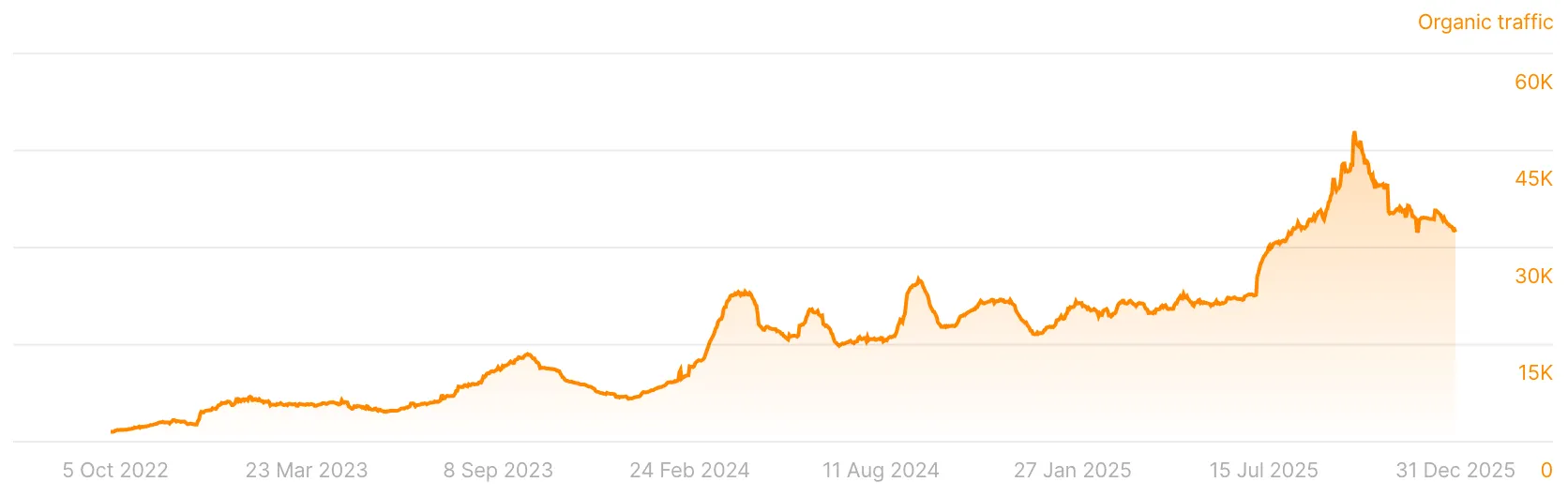
Organic traffic: ~1,500 → ~50,200/month at peak (+3,167%)
SSL Dragon in Ahrefs: Domain Rating and organic traffic
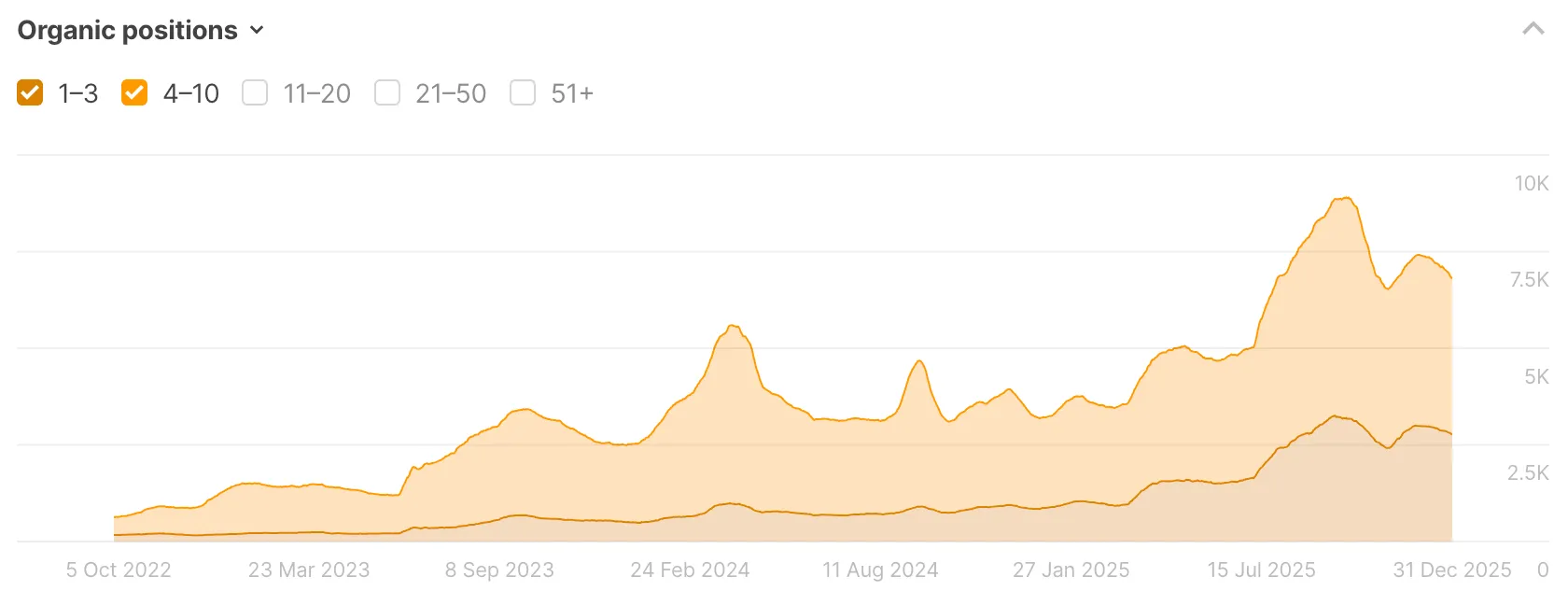
Top-10 keywords: 633 → 8,845 at peak (+1,297%)
Top 1–3 positions: 169 → 3,229 at peak (+1,810%)
SSL Dragon organic positions in Ahrefs
Non-branded traffic: ~705 → ~41,900/month at peak (+5,843%)
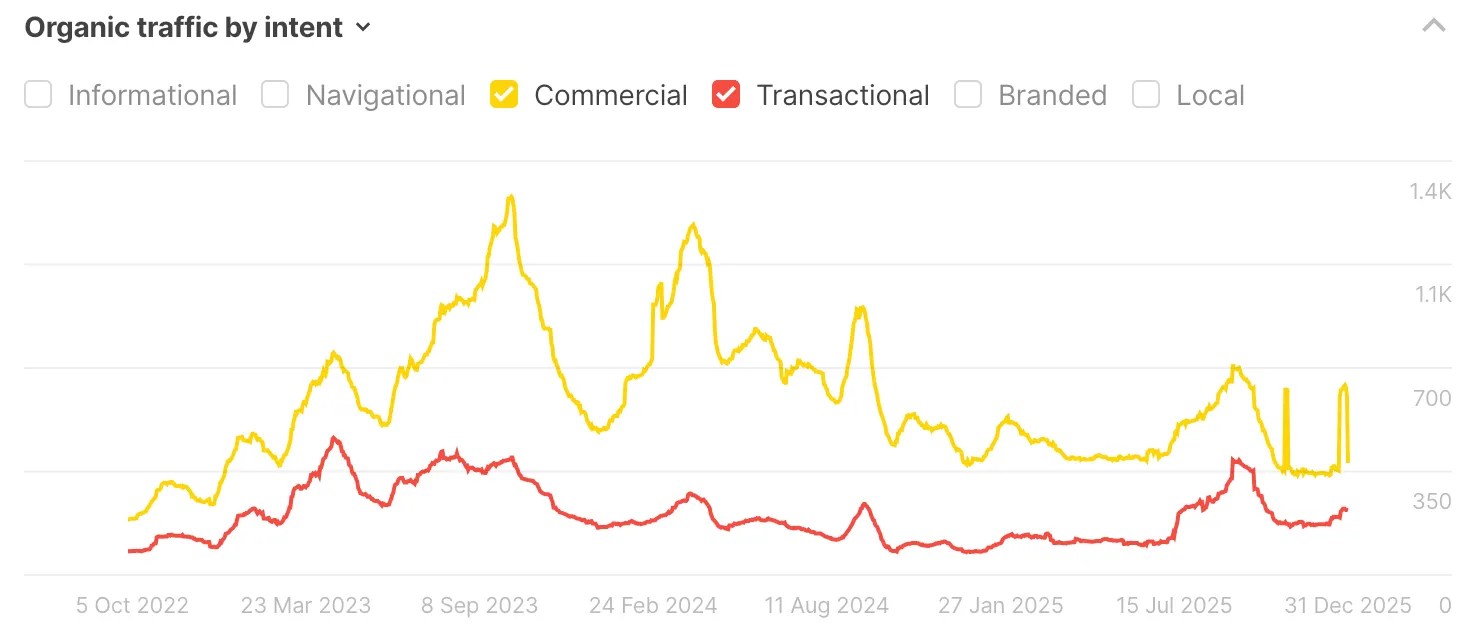
Commercial-intent traffic: ~188 → ~1,400/month (+645%); Transactional: ~80 → ~1,000/month (+1,150%)
SSL Dragon organic traffic by intent in Ahrefs (commercial and transactional)
Domain Rating: 25 → 64 (+156%); Referring domains: 264 → 2,700+ (+923%)
Google Search Console
Peak clicks: 79,559/month (March 2024); Peak impressions: 3.76 million/month (September 2024)
Average position improved from ~22 to 10.8 (October 2025)
Keyword rankings
112 #1 positions across international markets, including:
- “port 443”: #1 in Germany (2,000 volume), Switzerland (400), Austria (250)
- “443 port”: #1 in Russia (1,200 volume)
- “err_bad_ssl_client_auth_cert”: #1 in Spain (800 volume)
- “what is openssl”: #1 in US (700 volume) and India (400)
- “err_cert_authority_invalid”: #1 in Egypt (600 volume)
- “puerto 443”: #1 in Spain (400), Mexico (350), Colombia (200)
Top GSC queries (September 2025)
| Query | Position | CTR | Monthly clicks |
|---|---|---|---|
| openssl windows (ES) | 2.2 | 30.6% | 551 |
| pr_end_of_file_error (RU) | 1.9 | 29.8% | 521 |
| openssl windows (DE) | 2.8 | 23.6% | 499 |
| openssl windows (RU) | 2.5 | 32.3% | 460 |
| err_ssl_protocol_error (AR) | 2.8 | 13.8% | 420 |
| err_ssl_version_or_cipher_mismatch (RU) | 2.9 | 14.7% | 345 |
All the top query-page combinations are non-English.
Multilingual performance (September 2025)
| Language | Monthly clicks | Pages |
|---|---|---|
| English | 15,559 | 3,052 |
| Russian | 13,599 | 882 |
| French | 7,986 | 731 |
| German | 7,698 | 788 |
| Spanish | 7,317 | 844 |
| Portuguese | 2,810 | 692 |
| Arabic | 2,689 | 584 |
| Romanian | 1,753 | 650 |
Top-performing content
| Article | Peak monthly clicks |
|---|---|
| Install OpenSSL on Windows (all languages) | 5,600+ |
| Check SSL Certificate with OpenSSL in Linux | 5,121 |
| HTTPS Port 443 (all languages) | 3,600+ |
| Install SSL on Ubuntu | 2,722 |
| Convert CRT to PEM (all languages) | 2,500+ |
| Install SSL on Linux | 2,178 |
These six content clusters alone generated over 22,000 monthly clicks at their peaks, nearly 15x the site’s starting traffic.
Impact
Over three years, SSL Dragon went from an under-optimized site with ~1,500 monthly organic visits to a multilingual content authority peaking at 50,000+ visits, with 8,800+ top-10 keywords, 112 #1 positions across 10+ countries, and GSC clicks reaching nearly 80,000/month. The multilingual expansion made the biggest difference: non-English content drove 78% of traffic at peak, with individual guides generating 10x more clicks from translated versions than from the English original. In a niche dominated by Certificate Authorities with large budgets, a certificate reseller grew by competing on content rather than brand authority.