
There’s a moment in most SEO engagements where you have to decide whether to double down on what’s working or change direction entirely. I hit that moment while working on the organic growth strategy for a SaaS client.
We had a blog article that was performing well. It was ranking in the top 4–6 positions for several informational keywords in a competitive niche. The traffic was real, the rankings were stable, and by most standards, the content strategy was delivering.
I recommended scrapping the approach and building a free tool instead.
The keyword cluster that started it all
During keyword research, I found a cluster of queries with significant combined search volume. There were dozens of variations, all circling the same user need: people wanted to perform a specific calculation online.
The obvious move was to write a blog article targeting the informational variants in this cluster. Keywords starting with “how to…” had solid search volume and matched what a content-driven SEO strategy would typically pursue.
So that’s what we did first. And it worked. The article ranked, it drove traffic, and it validated that this keyword cluster was worth pursuing.
But I wasn’t satisfied with positions 4–6. So before planning the next article, I manually reviewed the actual search results for the highest-volume keywords in our cluster.
What the SERPs were telling us
For the head terms, the top results weren’t articles. They were tools. Interactive applications where you enter your inputs and get results instantly.
Our blog article was competing for a different version of the same query. It answered “how do I do X?” with an explanation. But the users typing “[X] calculator” didn’t want an explanation. They wanted to do X. Right now. On that page.
Google understood this distinction and ranked accordingly. The informational content sat in positions 4–10. The tools sat in positions 1–3.
The problem is that standard keyword research tools don’t surface this. They’ll show you the search volume for “how to do X” and “[X] calculator” side by side and let you decide what to create. If you default to writing articles for everything, you’ll rank well for the informational variants and hit a ceiling for the tool-intent ones. The only way to catch the difference is by looking at what’s actually ranking.
The recommendation
I went back to the team and recommended building an actual free tool that performs the calculation users were searching for. Not a blog post about how to do it. Not a listicle of existing tools. A real, functional application that solves the problem on the page.
This was a bigger investment than writing another article. It required development resources, an API integration, and a user interface that worked well enough to compete with established tools. It was a harder sell than “let’s publish three more blog posts this month.”
But the SERP data was clear. If we wanted to rank for the head terms in this cluster, we needed to match the content format that Google was already rewarding.
What happened
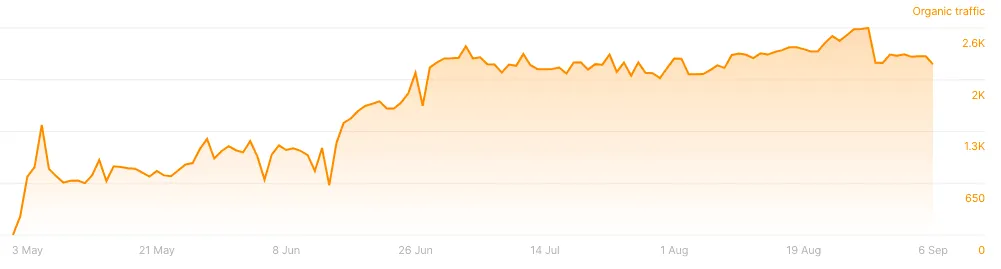
The tool launched and immediately outperformed the blog article. Where the article had plateaued in positions 4–6 for informational queries, the tool reached position 2–3 for the high-volume head terms. Keywords that the article could never have ranked for because it was the wrong format for the intent.
The organic traffic growth was visible almost immediately. The tool page went from zero to ranking for hundreds of keywords, with the vast majority in positions 1–3.
What we didn’t expect was what happened after the rankings stabilized. The tool was originally meant to be a top-of-funnel asset: drive traffic, introduce users to the company’s product ecosystem, collect email signups. But the usage data told a different story. People were coming back. Using the tool as part of their regular workflow, not just visiting once.
That repeat engagement led to the decision to launch a paid version with premium features. The free tool continued to serve as the organic traffic driver, while the paid version converted the most engaged users into subscribers. What started as an SEO recommendation became a standalone product line.
The playbook that emerged
Once we saw the pattern work, it became repeatable. I identified additional keyword clusters with the same characteristics and recommended building more free tools. Each follows the same logic:
- Find the keyword cluster. Look for groups of queries where search volume is concentrated in tool-intent head terms rather than informational ones.
- Check the SERPs, not just the data. If articles dominate positions 1–3, write an article. If tools dominate, build a tool. The keyword research tool won’t tell you this. Only the actual search results will.
- Build something genuinely useful. A thin tool that exists only for SEO won’t retain users.
- Let usage data guide monetization. Don’t build the paid version first. Launch free, watch how people actually use it, and let the premium features emerge from what you observe.
This isn’t just my experience
The free tool approach has been a growth engine for some of the most successful SaaS companies in the world.
HubSpot’s Email Signature Template Generator is a page with almost no written content, just a functional tool. According to Ahrefs, it ranks for nearly 6,000 keywords, drives an estimated 134,000 monthly organic visits, and has earned over 22,000 backlinks. That’s $172,000 worth of equivalent ad spend from a single page that does one thing well.
Ahrefs itself built an entire suite of free tools: a backlink checker, a keyword generator, a SERP checker, a website authority checker, and more. Each one targets a high-volume tool-intent keyword cluster and introduces users to the paid platform. Their free tools page is one of the highest-traffic sections of the entire site.
CoSchedule took a narrower approach with their Headline Analyzer. Users type in a headline, get a score and recommendations, and in the process discover CoSchedule’s broader product suite. One tool, one keyword cluster, one entry point.
These companies didn’t arrive at this strategy by accident. They recognized that for certain keyword clusters, a tool is the only content format that matches what Google is rewarding.
The economics of tools vs. content
There’s a cost argument here that matters if you’re deciding where to put your SEO budget.
A blog article has a low upfront cost but an ongoing maintenance burden. It needs to be updated as competitors publish newer content, as information changes, and as Google’s freshness signals demand it. A well-performing article might need two or three optimization passes per year to hold its position. Multiply that across a library of hundreds of articles and content maintenance becomes a significant line item.
A free tool has a higher upfront cost. Development, possibly an API integration, testing, a user interface that actually works. But once built, the maintenance cost drops and the value compounds. Users come back without you having to produce anything new. Each return visit reinforces the brand relationship on its own.
The competitive dynamics are different too. A blog article competes with every other article targeting the same keyword, and the competitive set refreshes constantly as new content gets published. A functional tool competes with other tools, and building a working application is a much higher barrier to entry than writing a blog post. That asymmetry means tool-based rankings tend to be more stable over time.
Tools also attract backlinks passively, in a way most articles don’t. People link to tools as resources in their own content. That HubSpot page with 22,000 backlinks isn’t the result of an outreach campaign. It’s the result of being useful enough that other people want to reference it.
For budget-conscious teams, this reframes the question. It’s not “should we write 10 more articles or build one tool?” It’s “where does the next dollar of SEO investment generate the most durable value?”
Why this matters more now than it did two years ago
When I first made this recommendation, it was based on SERP analysis. The data showed that tools outranked articles for certain keyword types, and we should match the format. It was a tactical insight.
Since then, the strategic case for building tools instead of writing articles has gotten significantly stronger.
Google’s AI Overviews are reshaping how informational content performs in search. Seer Interactive tracked over 3,000 informational queries across 42 organizations and found that organic CTR dropped 61% for queries where AI Overviews appear. Even for queries without AI Overviews, organic CTR fell 41%. Zero-click searches have risen to nearly 70% of all queries, according to Similarweb data from mid-2025.
The content type getting hit hardest is exactly what most SEO strategies produce: how-to articles, explainers, definitions, tutorials, and comparison content. Google can now summarize these directly in the search results, and users increasingly don’t need to click through.
Tools are structurally resistant to this trend. Google can summarize an article about how to perform a calculation. It cannot replace the calculation itself. A user still needs to visit the tool, enter their specific inputs, and get their specific result. That interaction can’t be compressed into an AI Overview.
The free tool approach I stumbled into through SERP analysis has become more relevant because of this shift. Tools aren’t just better at matching tool-intent queries. They’re more defensible against the broader erosion of informational content in search. A tool requires user interaction, delivers personalized output, and builds the kind of habitual usage that keeps people coming back regardless of what Google does with its search results page.
If you’re building an SEO strategy in 2026 and the plan is still “publish more blog posts targeting informational keywords,” you’re investing in the content category that’s losing the most ground.
In this project, one check of the actual search results turned a decent blog article into a tool that ranks for hundreds of keywords, attracts thousands of monthly visits, and generates its own revenue. The blog article is still live, still ranking for its informational keywords. But the tool is what moved the needle.